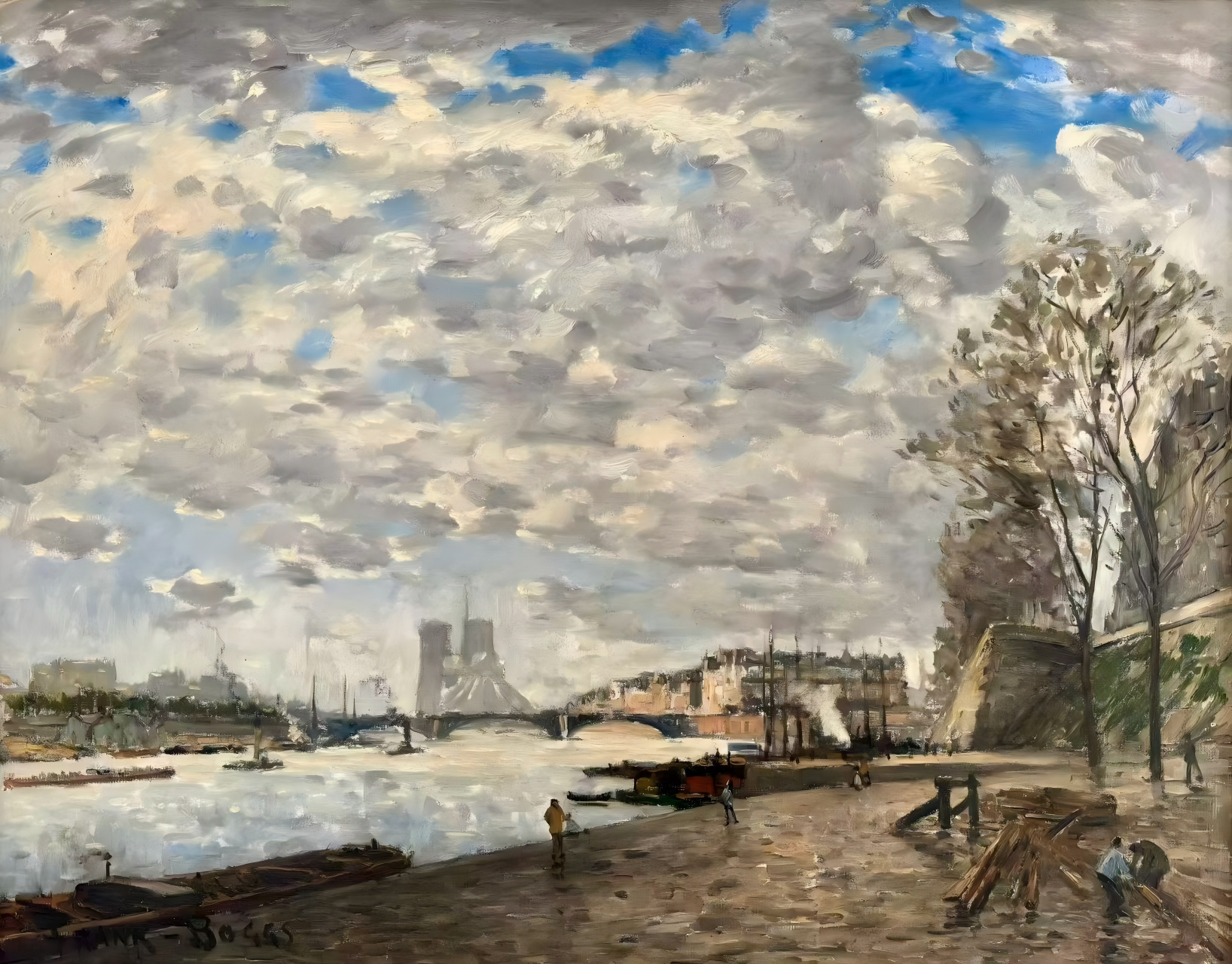
Frank BOGGS (1855-1926)
Quais sur la Seine à Paris derrière Notre-Dame
Huile sur toile
77 x 98 cm
Signée en bas à gauche
Frank Myers Boggs was born on December 6, 1855 in the United States.
At the age of seventeen, he found work as a wood engraver for the renowned magazine Harper's Weekly. At twenty‑one, he went to Paris, hoping to study stage set design. After failing to find an apprenticeship as a stage designer, he entered the École des Beaux‑Arts in Paris, where he studied painting under the academic master Jean‑Léon Gérôme. Boggs returned to Paris in 1880 and spent most of the rest of his career in France. Blending elements of Tonalism and Impressionism, he created a novel artistic style at the crossroads of American and European art traditions at the turn of the century.
He excelled at painting atmospheric landscapes, but he was more interested in the soft light of foggy mornings and rainy afternoons than in the brilliant sunshine favoured by his Impressionist colleagues.
Boggs had a keen sensitivity to changes in atmosphere and light, and he enjoyed depicting rain‑streaked streets and hazy, smoke‑filled skies in order to capture the subtle effects of reflected light.
His colour palette is known for its subtle, harmonious nuances of blue, grey and green. For this reason, his style has sometimes been compared to the Tonalism of James McNeill Whistler. Although his brushwork later became looser and his palette brighter, he never fully adopted the Impressionist method. His work found its most natural subjects in harbours, docks, the banks of the Thames and the Seine, and the street scenes of small French towns.
Frank BOGGS (1855-1926) was a painter born in Ohio, United States, who settled permanently in Paris as an adult. He studied at the École nationale supérieure des beaux-arts de Paris under the academic master Jean-Léon Gérôme, but his style was profoundly influenced by the Dutch marine painter Jongkind: he preferred the mists of dawn and dusk and the soft light of the Seine after rain, rather than the brilliance of sunny days.
In 1886, Boggs's studio was on the Boulevard de Clichy – a neighbourhood then much frequented by avant-garde Parisian artists.
The year 1886 was when Van Gogh arrived in Paris and began to discover Impressionism. That same year, Boggs was also active in Montmartre, and the two artists' studios were geographically very close. It was there that they met, sharing the same era and the same neighbourhood of Parisian artistic life. Vincent visited his studio and praised his works.
Today, the Van Gogh Museum holds two paintings by the Franco-American artist Frank Myers Boggs (1855-1926): Coal Barges on the Thames (c. 1883-86) and The Port of Honfleur (1884-86).
These two works were most likely obtained by Van Gogh in 1886 through an exchange of paintings. At the time, both canvases bore a signature and a dedication to Van Gogh. (They exchanged their works with each other and inscribed warm dedications on the canvases, proving that there was a certain camaraderie between Vincent and Boggs. It is likely that this relationship was established through Theo. As manager of a branch of the Goupil house (which became Boussod, Valadon & Cie from 1884 onward), Theo had regularly represented Boggs's works since 1882.)
Boggs's work offers us precisely "the other face" of the Paris in which Van Gogh lived – not the swirling, fiery skies that Van Gogh painted, but the misty, rainy everyday scenes of the Seine.