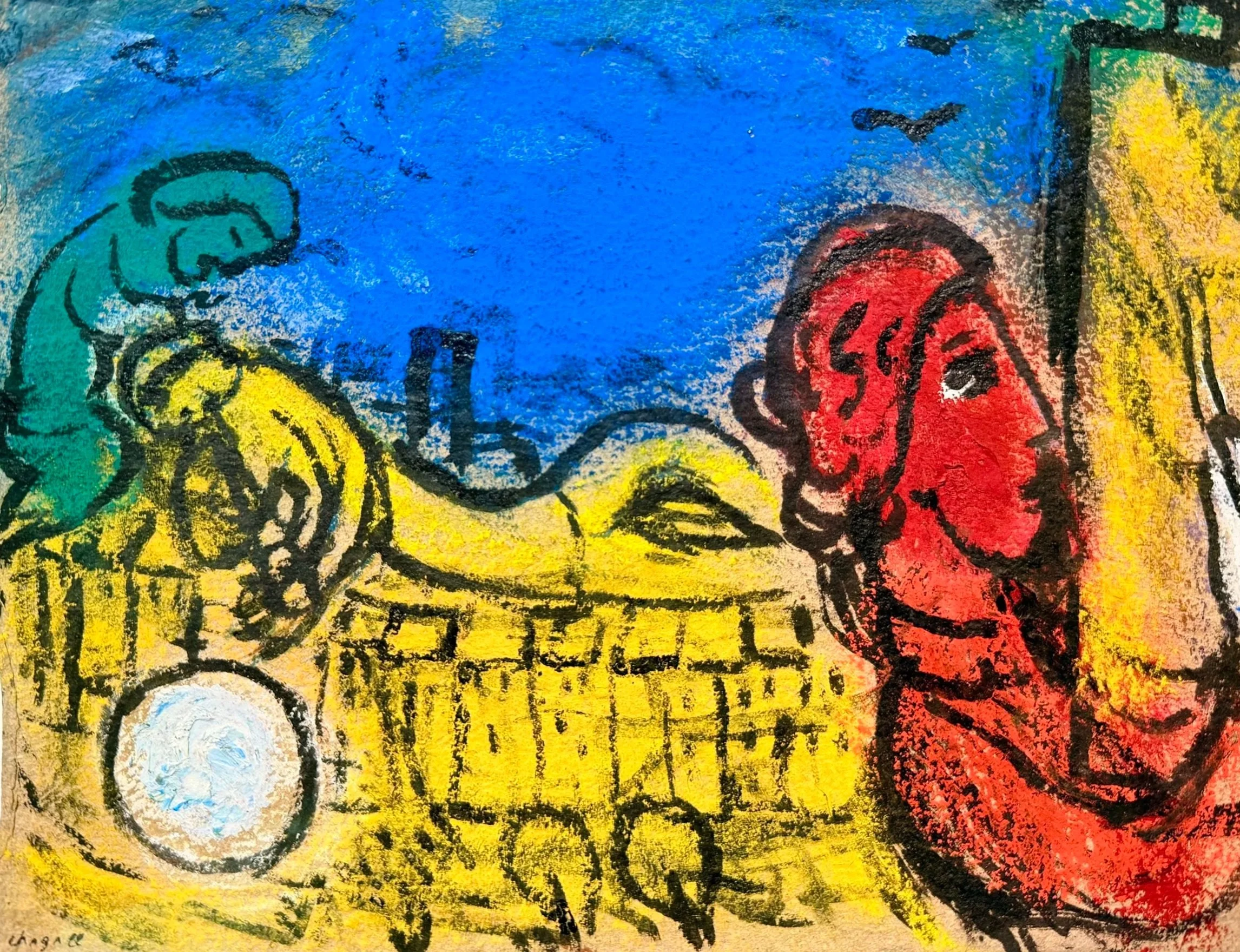
Marc CHAGALL (1887-1985)
« Peintre en rouge et sa déposition sur toits jaunes »
circa 1962-65
gouache, encre de Chine et huile sur papier coloré
22.4 x 28.7 cm.
Cachet officiel de la succession de Marc Chagall en bas à gauche
Provenance :
The estate of the artist, and thence by descent.
Private collection .France.
The Comité Marc Chagall has confirmed the authenticity of this work
Chagall is a master of 20th-century modern art, on a par with Picasso and Matisse, and is widely recognized as "the last survivor of the first generation of European modernists." He remained outside any single movement such as Impressionism, Cubism, or Surrealism, developing a uniquely personal style — dreamlike compositions, vivid and intense colors, floating figures and animals, autobiographical themes, and elements of Jewish culture. Picasso once praised him: "When Matisse dies, Chagall will be the only painter left who understands what color really is."
Chagall is hailed as a "genius of color." His colors are not naturalistic imitation, but a direct expression of emotion and spirituality. Blue is seen as a symbol of spirituality and the sacred, red represents passion and life, and yellow symbolizes the radiance of heaven.
This work belongs to Chagall's mixed-media on paper creations from the mid-1960s. During this decade, he increasingly used gouache, ink, and oil paint on colored paper, developing a freer, more spontaneous, and poetic pictorial language. During this period, he left the seaside and moved to a studio in a pine forest in the mountains, where his brushwork became more intense. His paintings often weave vivid reds, blues, and yellows together, creating a dreamlike atmosphere. The self-portrait figure of the "red painter" appears repeatedly in Chagall's works from the 1960s to the 1980s, often symbolizing the artist's self-projection and a celebration of life and love.