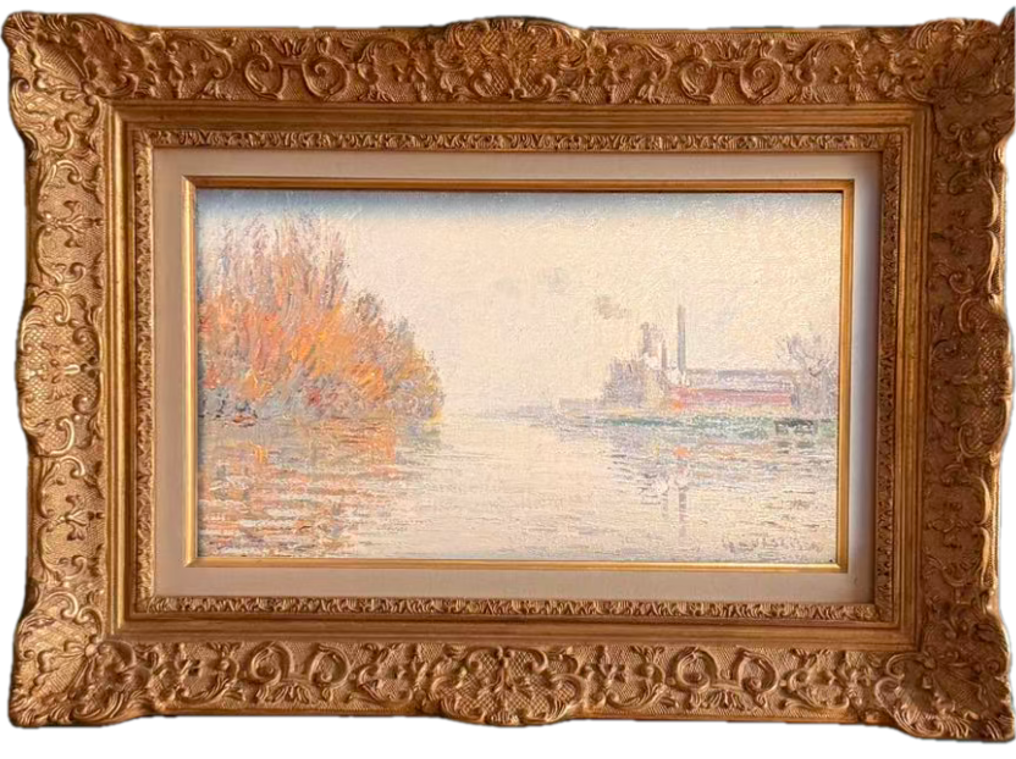
Gustave LOISEAU (1865-1935)
Brume sur l'Oise
Huile sur toile
27x46 cm
Signée en bas à droite
Gustave Loiseau was an indispensable figure among the French Post-Impressionist landscape painters from the late 19th century to the early 20th century. He was a quiet yet highly skilled observer who captured not only the appearance of the French countryside but also its rhythm and life pulse through his brushstrokes. His artistic career spanned the peak of Impressionism and the diverse exploration of Post-Impressionism, and he occupied a unique position in French art history with his original cross-hatching technique, acute perception of natural light and shadow, and repeated depictions of the same subject under different conditions.
Loiseau is regarded as a "pure landscape painter," and the depiction of French rural scenery along the Oise and Seine rivers runs throughout his entire artistic career.
He is a key figure connecting Impressionism with later movements. In certain aspects of his work, one can see connections to Monet's art; some of his treatments of reflections in water are even thought to foreshadow certain features of Monet's Water Lilies series.
The Oise River, mentioned in the title, is a subject Loiseau loved. He frequently painted the scenery of this region around 1900. His creative peak was from the 1890s to the early 1900s, and he is considered one of the representative figures of Post-Impressionism.
Deeply influenced by Impressionism, his works focus on the changing effects of light in nature. He had a particular preference for depicting quiet, misty atmospheres such as morning fog and white frost, and this is clearly reflected in the present work. He often employed a high horizon line in his compositions and excelled at rendering rich textures.